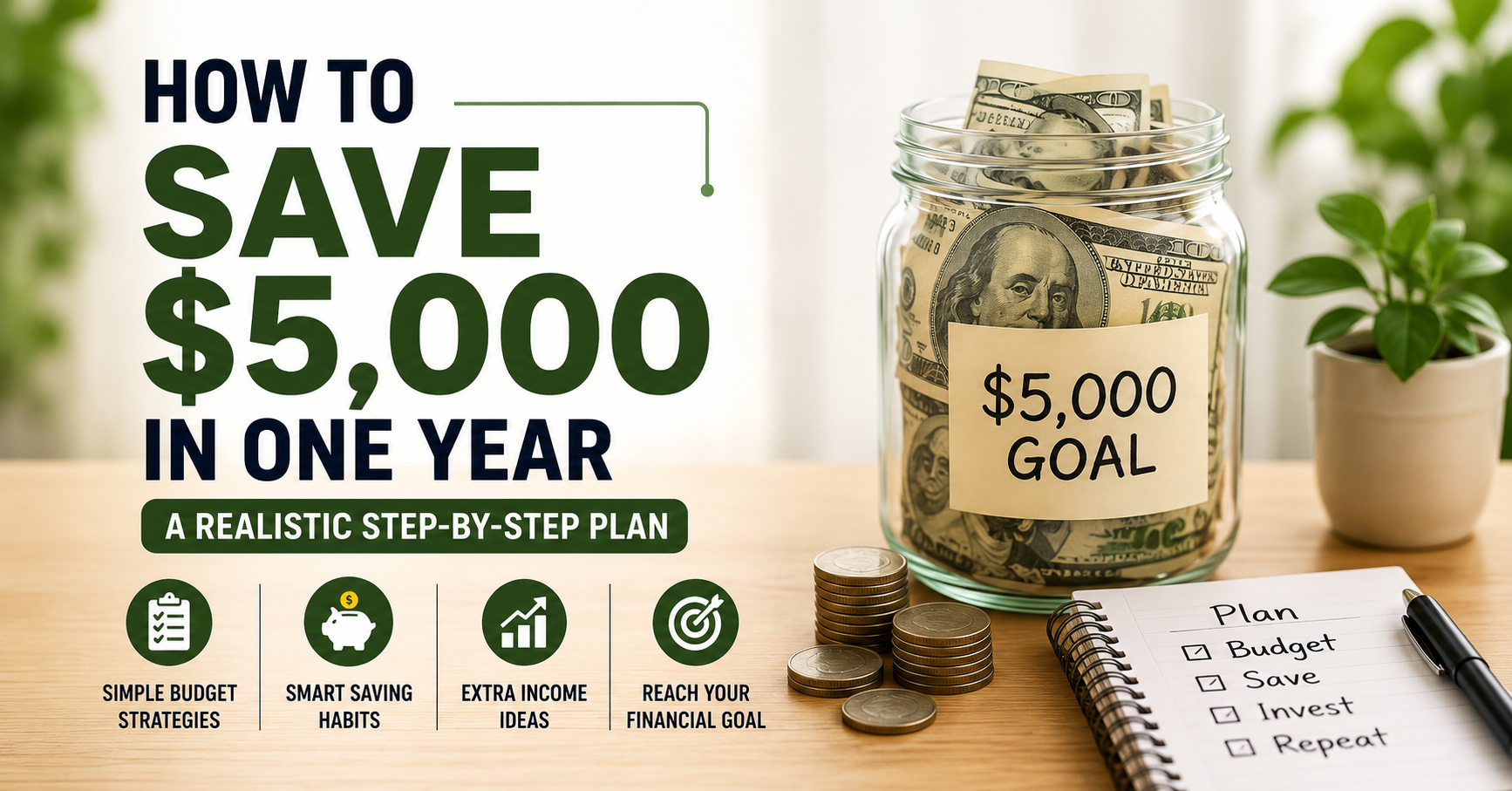
Saving $5,000 in one year may sound difficult, especially when everyday expenses keep increasing. However, the goal becomes much easier when you divide it into smaller monthly, weekly, and daily targets.
To save $5,000 within 12 months, you need to put aside approximately:
| Saving frequency | Amount to save |
|---|---|
| Per month | $416.67 |
| Every two weeks | $192.31 |
| Per week | $96.16 |
| Per day | $13.70 |
You do not have to find the entire $416 from one source. A combination of spending cuts, automatic transfers, extra income, and occasional windfalls can help you reach the goal without completely changing your lifestyle.
1. Decide What the $5,000 Is For
Before starting, give your savings goal a clear purpose.
You might be saving for:
- An emergency fund
- A vacation
- A car down payment
- Moving expenses
- Home repairs
- Starting a small business
- Paying down debt
A specific goal is usually easier to follow than simply saying, “I want to save more money.”
Name your savings account based on your goal, such as Emergency Fund, New Car, or $5,000 Challenge. Seeing the purpose every time you check your balance can help you stay focused.
2. Review Your Monthly Budget
A budget is a plan showing how much money you expect to receive and how you intend to spend or save it. Before setting a savings target, review your income and regular expenses so that your plan is realistic.
Start by listing:
- Monthly take-home income
- Rent or mortgage
- Utilities
- Food and groceries
- Transportation
- Insurance
- Debt payments
- Subscriptions
- Shopping and entertainment
Next, review your bank and card statements from the last two or three months. Look for expenses that can be reduced without affecting your essential needs.
Even several small changes can create a meaningful monthly saving amount.
3. Automate Your Savings
One of the easiest ways to stay consistent is to schedule an automatic transfer from your checking account to a separate savings account.
The FDIC recommends automatic transfers as a way to move money into savings before it is spent. Transfers can be scheduled for payday, weekly, or monthly, depending on how you receive your income.
For example, you could automatically transfer:
- $208 twice per month
- $192 from every biweekly paycheck
- $96 each week
- $417 once per month
Schedule the transfer shortly after payday rather than waiting until the end of the month. Waiting to save “whatever is left” often makes progress less predictable.
4. Find $200 by Reducing Expenses
You do not need to remove everything enjoyable from your budget. Instead, choose a few categories where you regularly overspend.
Here is one possible example:
| Expense change | Monthly savings |
|---|---|
| Cancel unused subscriptions | $30 |
| Reduce restaurant and delivery orders | $70 |
| Lower entertainment spending | $40 |
| Compare phone or internet plans | $30 |
| Plan groceries before shopping | $30 |
| Total | $200 |
Saving $200 per month from expenses would produce $2,400 in one year.
When reviewing expenses, focus first on recurring charges. Reducing a monthly expense usually saves money repeatedly without requiring a new decision every day.
5. Earn an Additional $217 per Month
After finding $200 in your current budget, you would need approximately $217 more per month to reach the $416.67 target.
Possible ways to earn extra money include:
- Freelance writing or design
- Weekend or evening work
- Selling unused clothing or electronics
- Pet sitting or house sitting
- Online tutoring
- Delivery work
- Social media management
- Selling digital templates
- Offering photography or editing services
An extra $55 per week would provide approximately $2,860 over 52 weeks.
Choose an income method that matches your existing skills and schedule. Avoid opportunities that require large upfront payments or promise guaranteed returns.
6. Use a Separate Savings Account
Keeping your $5,000 goal separate from everyday spending money makes it easier to track progress and reduces the temptation to spend it.
For a short-term goal, consider an account that:
- Has no monthly maintenance fee
- Does not require a high minimum balance
- Allows automatic transfers
- Provides convenient access when genuinely needed
- Pays a competitive interest rate
Compare the account’s fees, withdrawal rules, minimum balance requirements, and annual percentage yield before opening it.
Interest can add a small amount to your total, but your regular contributions will create most of the progress.
7. Follow This 12-Month Savings Schedule
Use the following targets to check whether you are on track:
| Month | Total savings target |
|---|---|
| Month 1 | $417 |
| Month 2 | $833 |
| Month 3 | $1,250 |
| Month 4 | $1,667 |
| Month 5 | $2,083 |
| Month 6 | $2,500 |
| Month 7 | $2,917 |
| Month 8 | $3,333 |
| Month 9 | $3,750 |
| Month 10 | $4,167 |
| Month 11 | $4,583 |
| Month 12 | $5,000 |
Check your progress at the end of each month.
When you save less than planned one month, do not abandon the goal. Divide the missing amount across the remaining months.
For example, when you are $120 behind with six months remaining, adding $20 to each remaining monthly target can bring you back on schedule.
8. Save Unexpected Money
Unexpected income can help you reach your goal faster.
Consider saving part or all of:
- Tax refunds
- Work bonuses
- Cash gifts
- Overtime pay
- Refunds
- Cashback rewards
- Money from selling unused belongings
You could use a simple rule such as saving 50% of every unexpected payment. This allows you to enjoy some of the money while still accelerating your progress.
9. Try a No-Spend Weekend
A no-spend weekend means avoiding optional purchases for a limited period.
You can still pay for essential expenses, but avoid:
- Restaurant meals
- Online shopping
- Paid entertainment
- Impulse purchases
- Convenience-store spending
Use food already available at home, enjoy free local activities, and transfer the amount you would normally spend into savings.
Saving $40 during one no-spend weekend each month would add $480 in one year.
10. Track Every Deposit
Tracking progress can make a long-term goal feel more achievable.
You can use:
- A spreadsheet
- A budgeting application
- A printable savings tracker
- A notebook
- A bank-account goal feature
Record each deposit and update your total at least once per week.
You can also divide the $5,000 goal into 50 smaller milestones of $100 each. Every time you save another $100, mark off one section of your tracker.
A Realistic Monthly Example
Here is one way to reach the monthly target without relying on one major lifestyle change:
| Source | Monthly amount |
|---|---|
| Automatic payday savings | $200 |
| Reduced food delivery | $70 |
| Cancelled subscriptions | $30 |
| Extra freelance income | $80 |
| Selling unused items | $40 |
| Total saved per month | $420 |
Saving $420 per month would result in $5,040 after 12 months, excluding any interest earned.
What If Your Income Changes Every Month?
People with freelance, seasonal, or commission-based income may find a fixed monthly amount difficult.
Instead, save a percentage of each payment.
For example:
- Save 10% of regular income
- Save 25% of income above your monthly average
- Save 50% of bonuses or unexpected payments
During higher-income months, contribute more. During lower-income months, maintain a smaller minimum contribution so that the saving habit continues.
Common Mistakes to Avoid
Do not make the plan so strict that you cannot maintain it. A realistic plan followed for 12 months is more effective than an extreme plan abandoned after several weeks.
Other common mistakes include:
- Saving only at the end of the month
- Keeping savings in a spending account
- Ignoring small recurring charges
- Depending entirely on extra income
- Withdrawing savings for nonessential purchases
- Giving up after one difficult month
Progress does not need to be perfect. Consistency matters more than following the plan exactly every week.
Frequently Asked Questions
How much should I save each month to reach $5,000 in one year?
You need to save approximately $416.67 per month for 12 months.
How much should I save per week?
You need to save approximately $96.16 per week for 52 weeks.
Is saving $5,000 in a year realistic?
It can be realistic when your income covers essential expenses and you combine expense reductions with additional income. The right plan depends on your income, debts, household expenses, and financial responsibilities.
Where should I keep the money?
For a short-term goal, many people use a separate savings account that has low fees, convenient access, and a competitive interest rate. Review the terms of any account before depositing money.
What should I do if I miss a monthly target?
Calculate how much you are behind and divide that amount across the remaining months. You can also use extra income, sell unused items, or temporarily reduce optional expenses.
Final Thoughts
Learning how to save $5,000 in one year is less about making one dramatic financial decision and more about following a consistent system.
Start with the monthly target of $416.67, automate part of it, reduce a few recurring expenses, and find a manageable way to earn additional income. Track your progress regularly and adjust the plan when your circumstances change.
The earlier you begin, the more time you have to make small contributions add up to a meaningful result.